When Time Becomes Part of Care
Evidence from sepsis, stroke and laboratory care shows how delays within clinical processes can affect outcomes, revealing where operational change may create measurable value.
Healthcare does not move through isolated events.
A patient arrives. Information is gathered. Tests are ordered. Results become available. Clinicians review them. Decisions are made. Treatment begins. The patient is monitored, transferred or discharged.
Each step has its own purpose. But the time between them can also become part of the outcome.
Evidence from different areas of acute and inpatient care shows that this is not simply a matter of making processes faster. The timing of clinical review, treatment and the movement of information through the institution can be associated with measurable differences in clinical outcomes, length of stay and the efficiency of care.
For MGE, the value of this evidence is not in repeating that time matters. It is in understanding where time enters the operating reality, what creates the delay, and what an institution could change when the consequence is important enough to act.
When Time Becomes Part of Care
Three studies illustrate different points at which time can become operationally significant.
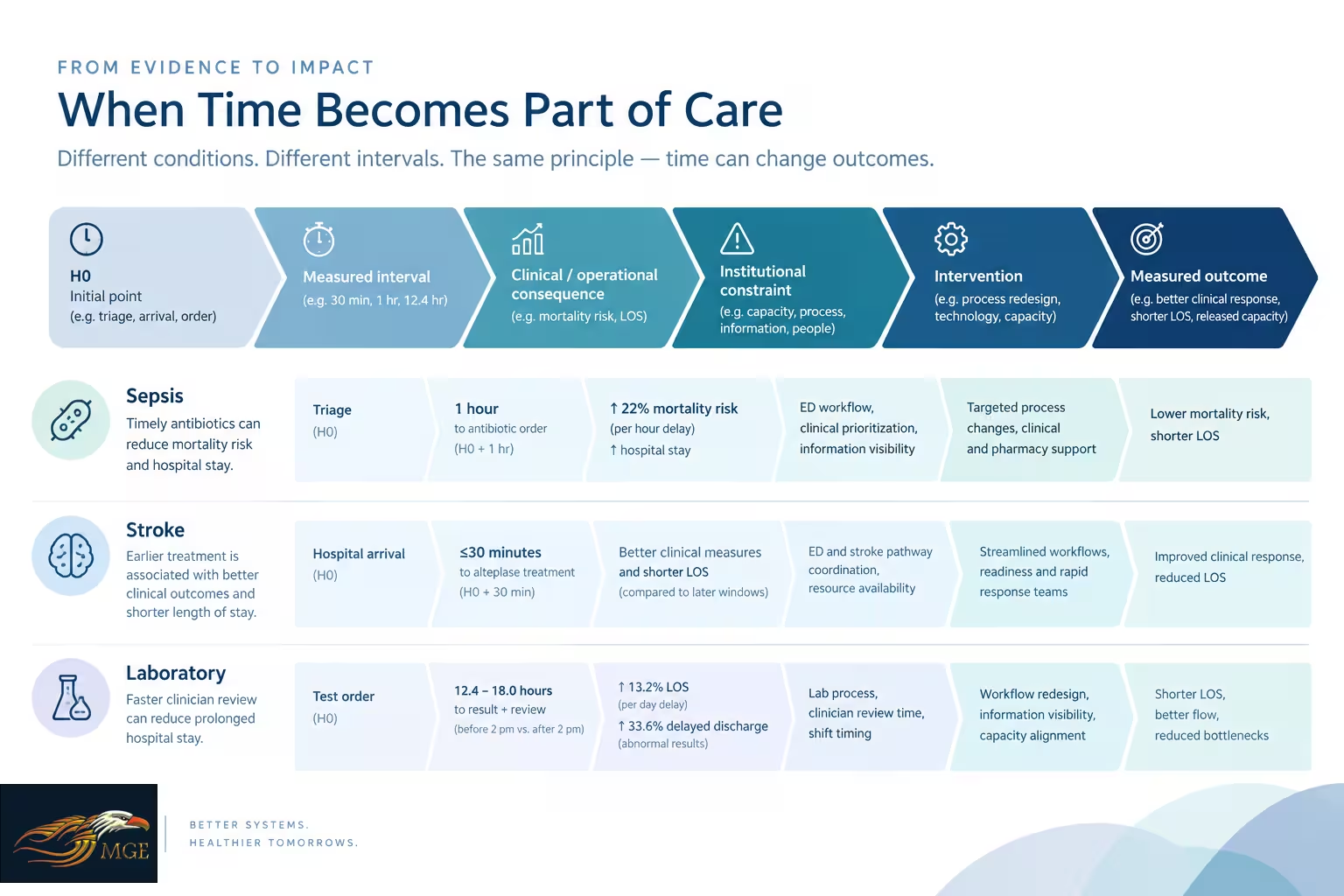
In an observational cohort of 117 patients with sepsis or septic shock, Kim et al. examined several intervals from emergency-department triage, including the time to antibiotic ordering and the time to antibiotic administration. The study did not find a significant association between total emergency-department time and mortality.
It did, however, find that, after adjustment for expected mortality, each additional hour from triage to antibiotic ordering was associated with a 22% increase in mortality risk, while each additional hour from triage to antibiotic administration was associated with a 15% increase in mortality risk. Both delays were also independently associated with increased hospital stay. [1]
The distinction matters.
The evidence does not say that every additional hour spent in an emergency department produces the same effect. It identifies particular intervals in the clinical process where delay was associated with material outcomes.
In acute ischemic stroke, Rajan et al. examined 752 patients treated with intravenous alteplase and compared treatment initiated within 30, 45 and 60 minutes of hospital arrival. Treatment within 30 minutes was associated with better post-treatment clinical measures and significantly shorter average length of stay. The study also found that the clinical benefits became smaller as the treatment window expanded. [2]
Here, the operational interval is explicit:
H0 → H0 + 30 minutes
The interval is not simply a process metric. It is connected to clinical and efficiency outcomes.
The laboratory evidence shows another point in the chain.
Ong, Magrabi and Coiera studied 5,804 inpatient admissions and examined the time clinicians took to review laboratory results after those results became available in the electronic reporting system. Each additional day of cumulative clinician review delay was associated with a 13.2% increase in the likelihood of prolonged hospital stay. When the analysis was restricted to abnormal results, each additional day of review delay was associated with a 33.6% increase in the likelihood of delayed discharge. [3]
The study also revealed an important operational pattern around the time of day.
For tests ordered before 2 pm, the combined laboratory turnaround and clinician review time averaged 12.4 hours, compared with 18.0 hours for tests ordered after 2 pm. Clinician review time itself averaged 5.2 hours before 2 pm versus 7.5 hours after 2 pm. [3]
The starting point can therefore be represented without inventing a hypothetical hospital scenario:
H0 = laboratory order
H0 + 12.4 h → average combined turnaround and review for tests ordered before 2 pm
H0 + 18.0 h → average combined turnaround and review for tests ordered after 2 pm
The evidence does not establish that a particular institution will experience these same intervals.
It establishes something more useful for operational thinking: the timing of the clinical process can change with the conditions under which the process operates.
That is where evidence becomes relevant to institutional design.
The Clinical Journey Is a Connected System
The studies do not describe the entire patient journey, and MGE does not need to reproduce the patient journey already described in its Healthcare Capacity & Care Delivery work.
What they reveal are points within that journey where the connection between activities becomes measurable.
A laboratory test is not only a laboratory activity.
A treatment order is not only a clinical decision.
A medication administration is not only a pharmacy or nursing activity.
Each depends on what has happened before it and on whether the next person, process, system or physical resource can act when required.
The studies therefore allow a different reading of the clinical journey.
Information has to become available.
Someone has to be able to act on it.
The required intervention has to reach the patient.
The next decision has to occur without avoidable interruption.
The importance of this connection is visible in the evidence itself.
Kim et al. did not identify total emergency-department duration as the significant mortality measure. The more specific intervals to antibiotic ordering and administration carried the demonstrated association. [1]
Ong et al. separated laboratory turnaround time from clinician review time and found that clinician review delay was significantly associated with prolonged length of stay. [3]
Rajan et al. examined the interval between hospital arrival and alteplase treatment and found measurable differences in clinical and efficiency outcomes across treatment windows. [2]
The operational lesson is therefore not simply that healthcare should be faster.
It is that the institution needs to know which intervals matter, what determines them and where an intervention can change them.
The Delay May Not Be Where It First Appears
A measured delay is an outcome of a system. It is not automatically the location of the constraint.
The distinction becomes clearer when the evidence is represented as time intervals rather than as isolated findings.
For example:
H0 = triage
H0 + 1 hour → antibiotic order
H0 + 2 hours → antibiotic administration
The Kim et al. study allows the significance of those intervals to be examined through its findings on mortality risk and hospital stay. [1]
Similarly:
H0 = hospital arrival
H0 + 30 min → alteplase initiation
H0 + 45 min → later treatment window
H0 + 60 min → later treatment window
The Rajan et al. study shows that these different door-to-needle windows were associated with different clinical and efficiency outcomes. [2]
And in the laboratory pathway:
H0 = laboratory order
H0 + laboratory turnaround → result available
H0 + laboratory turnaround + clinician review → result acted upon
The Ong et al. study shows that the latter interval is affected by when the test is ordered and by the time clinicians take to review the result. [3]
This changes the operational question.
Instead of asking only:
“Where is the delay?”
the institution can ask:
“Which interval is creating the consequence, what determines that interval, and which of its conditions can be changed?”
That is a substantially different starting point for intervention.
A longer interval may be created by capacity.
It may be created by timing.
It may be created by the availability or visibility of information.
It may be created by the movement of people, specimens, medicines or equipment.
It may be created by the relationship between departments whose individual processes appear to perform adequately when examined separately.
The evidence does not identify the constraint in another institution.
It gives the institution a reason to look for it.
From Evidence to Operational Options
Once a demonstrated operational consequence is understood, the question changes from whether the constraint exists to what can be done about it.
That does not require one predetermined answer.
The appropriate intervention depends on what the institutional baseline reveals.
A constraint in clinician review may require a change in workflow, responsibility, prioritization or information visibility.
A constraint in laboratory processing may require a change in capacity, routing, specimen handling or process design.
A constraint in pharmacy may require changes in availability, movement, preparation or integration with clinical workflows.
A constraint in physical movement may require redesign of the relationship between spaces, people, equipment and time.
And where technology can materially remove a demonstrated constraint, technology can become part of the intervention by design.
This is where MGE’s approach differs from beginning with a technology and asking where it can be installed.
The question is not whether technology should be used.
The question is whether the institutional constraint is sufficiently understood to determine where technology creates value, what it needs to connect, what capability must surround it and how the resulting change will be measured.
Where the answer is yes, MGE can move confidently toward technology because the reason for using it is already established.
Technology is then not the intervention’s justification.
The outcome is.
The Intervention Has to Reach the Outcome
The value of redesign becomes visible only when the change reaches an outcome that matters to the institution.
The evidence provides several ways to think about those outcomes.
In sepsis, reducing the time to antibiotic ordering or administration is connected in the Kim et al. study with mortality risk and hospital stay. [1]
In acute ischemic stroke, earlier alteplase treatment was associated with improved clinical measures and reduced length of stay in the Rajan et al. study. [2]
In inpatient laboratory processes, reducing clinician review delay represents an opportunity to address potentially avoidable hospital stays and resource utilization, with the study finding stronger associations when abnormal results were considered. [3]
Those findings can be translated into institutional measures.
The outcome may be:
- shorter time from arrival to treatment;
- shorter time from result availability to clinical review;
- reduced length of stay;
- improved clinical response;
- lower morbidity or mortality where the relevant clinical pathway and baseline support such measurement;
- released bed capacity where a reduction in length of stay produces measurable capacity;
- reduced pressure on clinical teams where unnecessary process burden is removed;
- fewer laboratory bottlenecks;
- fewer resampling or rejected samples where specimen handling is a demonstrated constraint;
- improved pharmacy responsiveness where medication availability or movement is part of the measured constraint;
- fewer operational incidents and stronger infection-control performance where physical movement, waste or spillage is demonstrated as a relevant constraint.
The institution can therefore move from a general ambition to measurable performance:
What is happening now?
What should change?
By how much?
Over what period?
What will demonstrate that the change has occurred?
A target such as releasing more than 10% of bed capacity may be appropriate in a particular institutional intervention, but it should be treated as a defined target arising from that institution’s baseline and capacity model, not as a result established by the studies discussed here.
The same discipline applies to clinical outcomes.
The evidence can establish the significance of particular time intervals. The institution’s own baseline establishes the starting condition. The intervention establishes what is changed. Measurement establishes whether the intended outcome was actually achieved.
That is how an ambition becomes an operational intervention.
From Demonstrated Constraint to Measured Change
Evidence can show that an interval matters.
Institutional analysis can show why that interval exists.
An intervention can then change the conditions producing it.
But the work is not complete when the intervention is installed or the process is redesigned.
The institution needs to see whether the intended change occurred.
This means establishing a baseline before intervention and measuring the relevant outcome after implementation.
If the objective is faster clinical response, the measurement should reach the relevant clinical response rather than stopping at system activation.
If the objective is reduced length of stay, the measurement should reach length of stay.
If the objective is laboratory flow, the measurement should show whether the bottleneck actually moved.
If the objective is staff capacity, the measurement should show whether time was genuinely released from the work that was creating the constraint.
If the objective is infection control, the relevant incident or process measures must demonstrate whether the operating condition improved.
The intervention therefore becomes a continuous chain:
Baseline → Constraint → Intervention → Measurement → Improvement → Institutional capability
The final step matters.
An improvement that depends entirely on an external intervention has not yet become institutional value.
The institution needs the capability to understand the new condition, maintain the change, recognize deterioration and act again when circumstances change.
What the Evidence Makes Possible
The importance of these studies is not limited to the individual clinical findings they report.
Together, they demonstrate different ways in which operational time can become connected to healthcare outcomes.
One study identifies measurable associations between delays in antibiotic ordering and administration and mortality risk and hospital stay.
Another shows that the timing of acute stroke treatment is associated with clinical and efficiency outcomes.
Another shows that clinician review time for laboratory results is associated with prolonged hospital stay and varies with when tests enter the operating cycle. [1–3]
These are different clinical contexts.
They should not be combined into one universal healthcare rule.
But they can be examined together to reveal an operational reality:
the time between activities can become consequential when the activities are part of a connected clinical process.
That recognition creates an opportunity.
The institution can examine where those consequential intervals exist in its own environment, what conditions produce them, and what could change them.
The resulting intervention may involve process, people, capacity, physical movement, information, technology, infrastructure or a combination of them.
What matters is that the intervention follows the demonstrated constraint rather than preceding it.
Carrying the Value Forward
The strongest outcome is not simply a shorter interval.
It is an institution that has become better able to understand and control the conditions that determine that interval.
That may mean a more visible process.
A clearer responsibility.
A better-connected laboratory, pharmacy and clinical workflow.
A more responsive physical environment.
A better use of available capacity.
A technology-enabled capability that removes a demonstrated constraint.
Or a combination of these.
The evidence provides the starting point for understanding what can matter.
The institutional baseline reveals where it matters.
The intervention changes what can be changed.
Measurement demonstrates whether value was created.
And continuity determines whether that value remains available after the intervention itself is no longer the focus.
This is where evidence becomes knowledge in practice.
Evidence → Healthcare reality → Operational constraint → Opportunity → Dare → Options → Intervention → Measurement → Value carried forward
The purpose is not to accept every constraint as inevitable.
Nor is it to redesign for the sake of redesign.
It is to recognize where the evidence shows that change can matter, understand the institutional conditions that determine the outcome, and have the confidence to act where the opportunity is real.
What can be demonstrated can be improved.
What is improved should become capability.
And what becomes capability should strengthen what comes next.
References
[1] Kim et al. (2018). Antibiotic Timing and Outcomes in Sepsis. American Journal of the Medical Sciences, 355(6), 524–529. DOI: 10.1016/j.amjms.2018.02.007.
[2] Rajan SS, Decker-Palmer M, Wise J, Dao T, Salem C, Savitz SI. (2021). Beneficial effects of the 30-minute door-to-needle time standard for alteplase administration. Annals of Clinical and Translational Neurology, 8(8), 1592–1600. DOI: 10.1002/acn3.51400.
[3] Ong MS, Magrabi F, Coiera E. (2018). Delay in reviewing test results prolongs hospital length of stay: a retrospective cohort study. BMC Health Services Research, 18, 369. DOI: 10.1186/s12913-018-3181-z.