
Continuous Learning
What changes as MGE learns
Continuous Learning records how MGE’s understanding and practice evolve through evidence, experience, testing and reflection.
New evidence may challenge an assumption. Experience may reveal a constraint that was not visible at the beginning. An intervention may show that an approach needs to change. These publications capture what changed, why it changed and what MGE is learning from it.
-
When the Parts Work but the Purpose Does Not
Operational readiness is not established by making each function perform well in isolation. MGE’s experience in supply and market access changed how it understands readiness: the real test is whether functions, information and decisions remain connected to the institutional purpose they are meant to fulfil.
MGE’s understanding of operational readiness has changed through experience.
Earlier in its practice, an operational problem was approached by identifying where the failure appeared and tracing its root cause within that function. A customs delay led to an examination of clearance. An inventory problem led to an examination of demand and purchasing. A rejected certificate led to an examination of documentation.
That analysis remains necessary. It is not always sufficient.
Experience in supply and market access showed that the visible failure and its underlying cause do not always belong to the same part of the operation. A transaction moves through procurement, production, quality, documentation, logistics, customs, finance and commercial commitments. Each function has its own responsibilities and measures of performance. The intended outcome, however, does not move through those functions separately.
It passes between them.
A supply decision made on attractive commercial terms changes when demand is no longer secured closely enough to the timing of delivery. A product that leaves a capable manufacturer with acceptable quality loses its market readiness when the materials used to reproduce it are inconsistent, its export packaging is inadequate, or the required evidence cannot be produced. A customs representative can know the clearance process thoroughly and still make the wrong classification when the technical nature and intended use of the product have not been understood.
The same pattern appears at a larger scale.
Regulatory changes, currency restrictions, geopolitical disruption and changes in trade routes can alter the conditions of a transaction while it is already underway. A route that was commercially viable becomes unavailable. A payment mechanism that was routine becomes difficult to execute. A product’s classification changes with its use or with a change in policy. The transaction has not necessarily been poorly managed; its surrounding conditions have changed.
This changed the question MGE asks when assessing readiness.
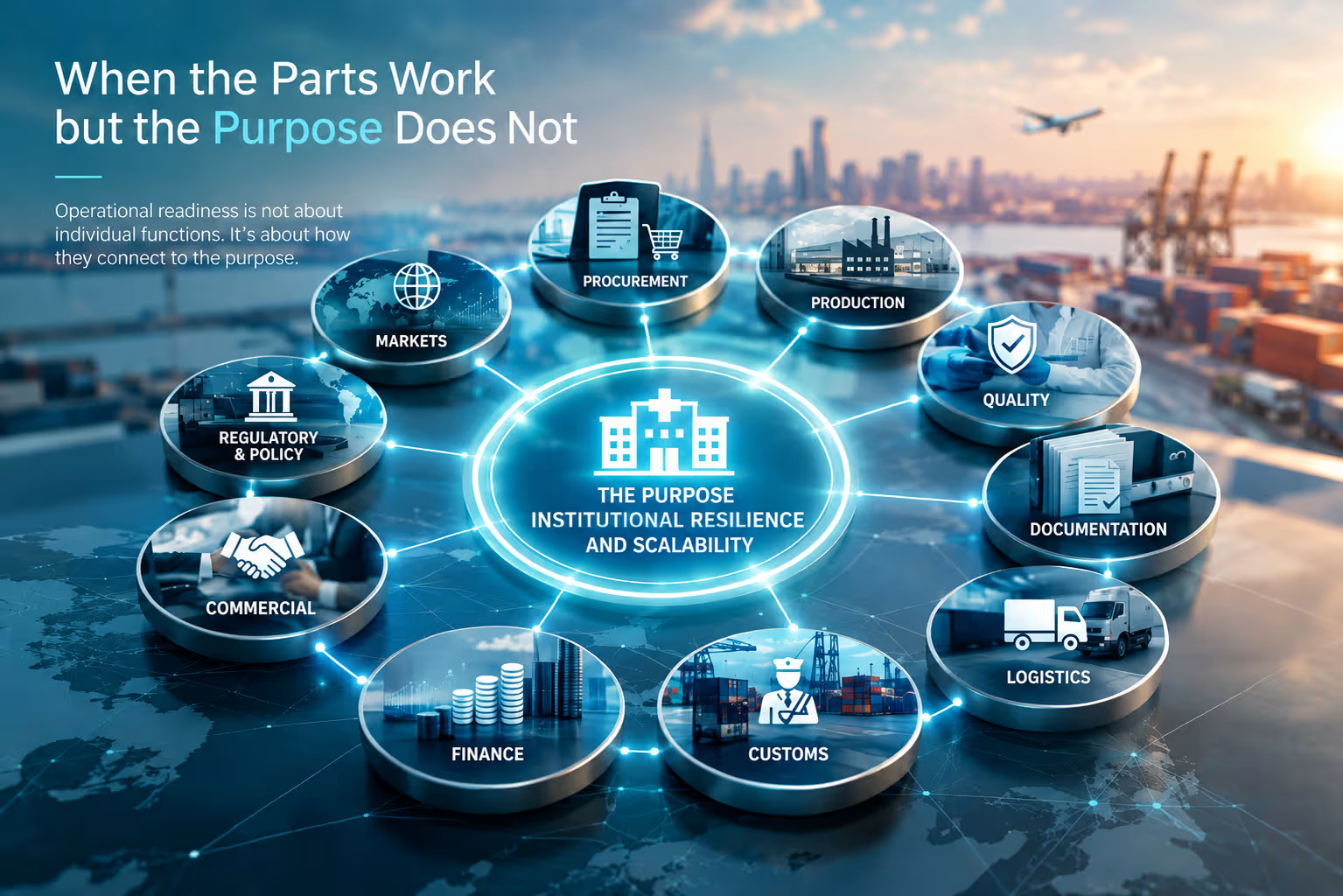
The question is no longer only whether each function is performing correctly. It is whether the functions, information and decisions remain connected to the purpose they are collectively expected to serve.
That distinction also changed how evidence is interpreted.
A signed sales inquiry is evidence of interest, not evidence that the transaction is ready. A functioning production line demonstrates production capability, not necessarily the continuity of the inputs required to sustain the product. A quality certificate establishes what it covers, but does not by itself establish traceability across the materials and components on which that quality depends. Complete customs documentation demonstrates that documents exist; it does not establish that the underlying product has been correctly understood and represented.
Readiness therefore has to survive the handoffs.
Information must remain accurate as it moves between people and organizations. Responsibilities must remain visible when work crosses organizational boundaries. Product, regulatory and commercial knowledge must meet where decisions depend on all three. The conditions surrounding supply, payment, logistics and delivery must continue to support the intended transaction.
This understanding also changed how MGE works.
Verification moved further upstream. Product claims, origin, quality and export requirements are examined before they become problems at the destination. Commercial commitments are considered together with the timing and conditions of supply rather than as separate events. External representatives are given the product knowledge required to exercise their professional role correctly. Manufacturers are examined not only through their finished output, but through the systems that determine whether that output can be reproduced consistently.
The purpose of these changes is not to make every function responsible for everything.
It is to prevent functional boundaries from becoming invisible boundaries around institutional purpose.
That became particularly important in volatile markets. Market access is exposed not only to what an institution controls internally, but also to policy, regulation, infrastructure, currency, logistics, supplier continuity and the behaviour of other institutions. Readiness therefore cannot be established by confirming that each internal component is functioning at one point in time. It has to be understood in relation to the conditions under which the whole transaction must continue to function.
This is the deeper change in MGE’s practice.
A problem that appears to belong to one function is now examined in relation to the operation around it. Evidence is considered not only for what it proves within a department, but for what it establishes about the institution’s ability to achieve its intended outcome. Decisions are no longer assessed only by whether they are correct within their immediate context, but by what they create downstream.
The result is a different understanding of operational readiness.
An operation is not ready because its parts are ready. It is ready when those parts remain connected to the purpose they are meant to fulfil.
And that is where MGE’s learning continues: not in making functions less specialized, but in understanding more clearly what happens between them.