The Problem Begins Before the Waste
Healthcare waste is often treated at the end of the process, after it has already become a cost and risk. But the decisions and operating conditions that generate unnecessary waste begin much earlier across procurement, inventory, clinical practice and workflow.
A hospital can have a healthcare waste-management procedure, trained staff and an approved disposal process—and still generate far more hazardous waste than its operation needs to.
Consider what happens when a department runs out of the bags intended for general waste. The staff know the segregation procedure. They use the available bags instead. A procurement and inventory decision has now changed the waste stream before the waste reaches the person responsible for managing it.
The same thing happens when a nurse, working through multiple clinical tasks, disposes of a syringe or another item into the wrong container. The procedure may be known. The error is still produced by the conditions in which the work is being performed.
Look further upstream and another connection appears. Procurement may select a lower-priced product without considering what its packaging, consumption pattern or disposal requirements will cost the hospital later. The purchase has been completed successfully. The cost has simply moved somewhere else in the operation.
These are not isolated waste-management incidents. They show how a waste stream can be created by decisions that were never made as “waste decisions.”
The problem becomes harder to see when each function manages only its own part. Procurement manages purchasing. Inventory manages stock. Clinical teams use supplies. Infection control manages safety. Housekeeping collects waste. Waste contractors treat and dispose of it. Each responsibility is legitimate. The waste, however, moves across all of them.
That separation can hide the cause.
A hospital may discover a high volume of hazardous waste at the collection point without being able to trace how much of it was created by procurement choices, availability of materials, clinical consumption, segregation conditions or workflow. Without that connection, the waste is treated as an output to be managed rather than an outcome that can be changed.
The same gap appears in physical movement. Waste streams may be placed in different bags but collected together, carried through corridors used by patients and visitors, or handled in ways that make the intended separation difficult to maintain. A procedure can therefore be correct on paper while the operating environment produces a different result.
And when waste is collected without reliable tracking, even a change in what happens between the ward and the storage area can remain invisible. Material can be removed, recovered or mixed without the institution being able to reconcile what was generated with what was received.
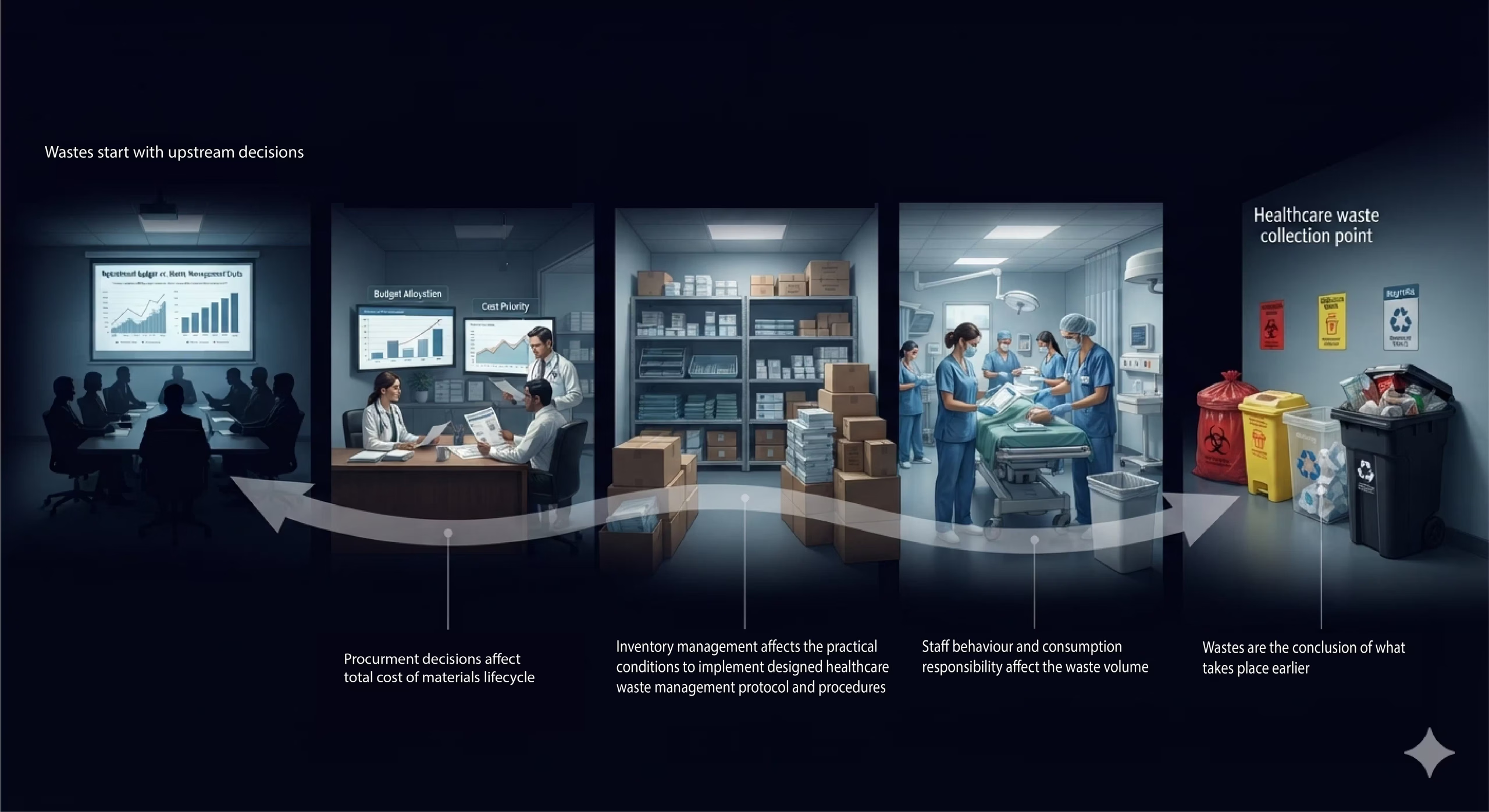
The consequence is not only more waste.
It can mean unnecessary hazardous-waste treatment, avoidable procurement and consumption costs, additional exposure risks, loss of recyclable material, and environmental impacts that no single department sees as its own.
This is why training alone cannot carry the whole burden. Evidence from healthcare facilities has found that segregation performance is associated not only with knowledge and training but also with practical conditions such as the availability of colour-coded waste containers and workplace guidance. WHO’s own guidance places waste minimization alongside segregation, handling, treatment and disposal, and identifies procurement choices, stock management, reuse where safe and viable, and other upstream measures as part of waste minimization.
The distinction is important.
The question is not simply whether a hospital is managing its waste correctly after it has been generated. The more consequential question is what is causing the hospital to generate that waste in the first place.
Once that question is asked across the operation, familiar problems begin to look different.
A segregation error can point to a supply or workflow constraint.
Excess hazardous waste can point to decisions about what is purchased, consumed and classified.
Repeated disposal of usable material can point to how products are selected, handled or controlled.
A procedure that is consistently bypassed can point to a process designed without sufficient regard for the conditions under which people actually work.
And a disposal bill can contain costs created much earlier than the moment at which the bill is received.
This changes what is possible.
Waste does not have to be accepted simply because it has become part of the hospital’s normal operating pattern. Necessary waste will remain. But unnecessary waste can be challenged at the decisions and conditions that create it.
That is where cost can be reduced rather than merely managed. Risk can be reduced before it reaches the disposal stage. Materials that would otherwise become a burden can, where safe and appropriate, retain or recover value.
The opportunity is therefore not to make waste disappear.
It is to stop treating the waste at the end of the process as if that is where the problem begins.
The waste is visible at the end. The opportunity to change it begins much earlier.